
Ep 24: What Nobody Sees After You Achieve Everything | Sara Blakely
October 6, 2026
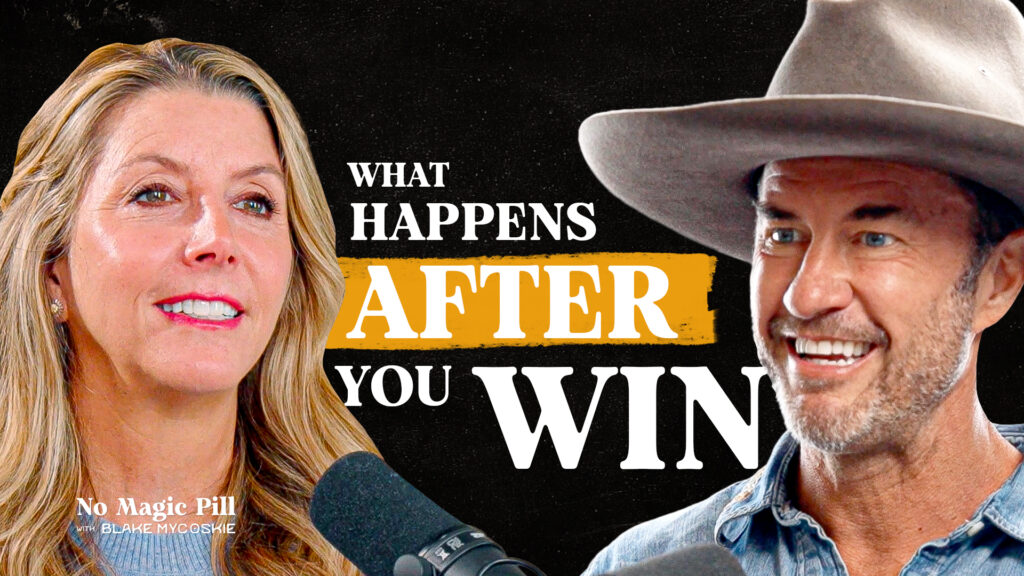
In this episode of No Magic Pill, Blake Mycoskie sits down with Sara Blakely, the woman who started Spanx with $5,000, built it into a billion-dollar company as its sole owner for 21 years, and then did it again with her shoe company Sneex. But this is not a business conversation. Blake and Sara have been checking in on each other at the pivotal moments of their lives for nearly 15 years, two bootstrapped founders with no investors and no board, and today that long-running conversation becomes the show.
Sara opens up about the grief that blindsided her after selling Spanx, the intervention staged by the friends who refused to watch her suffer, and why society has no framework for checking in on someone who just achieved everything. She goes back to the 16-year-old on a bedroom floor in Clearwater Beach who realized she had spent her whole life being taught what to think and never how to think, and traces that single realization through everything that followed, from the cocktail party where two men told her business is war, to the sign from the universe that launched a shoe company ten years in the making.
“Instead of being the passenger of my thoughts, I became the driver. And I never knew I could be the driver.” ~ Sara Blakely
What You’ll Learn
- Why the grief after a major achievement blindsides so many founders, and why nobody checks in on the person who just got everything
- How to recognize a true calling: a consistent whisper, felt in the body, that keeps coming back
- How to become the driver of your own thoughts instead of the passenger, and catch negative self-talk in its tracks
- Sara’s scorecard approach to balance, and why chasing perfect balance is the wrong goal
The Conversation
Two Founders, Fifteen Years of Check-Ins
Blake and Sara met at a dinner at Bill Gates’s house, the two youngest people in the room, right after Blake had discovered the secret trampoline room. What began there became a rare kind of friendship: two founders of fast-growing, investor-free companies who call each other only at the pivotal moments. One of those calls produced the best money advice Blake ever received. Wrestling with shame over the TOMS sale, he heard Sara tell him that money is really fun to make, really fun to spend, and really fun to give away, and that money simply makes you more of who you already are: more generous if you are generous, more insecure if you are insecure. It is a magnifying glass, and your relationship with it is often the block you cannot see.
The Call to Sell Spanx
For 21 years Sara was the sole owner of Spanx, its mother and its father. Then came what she describes as a calling, and callings, she says, arrive as whispers: easy to ignore, scary to accept, and always pointing into the unknown. Hers kept returning with total consistency, a feeling in the body rather than a mood, built around one piercing question: what would her life feel like if 80 percent of her mental share no longer belonged to Spanx? She walks through the decision to let go, the divorce analogy a founders’ coach gave her that finally captured the feeling of sitting on a board without control, and her advice to any founder considering a sale: be fully ready to let go of the outcome. Three quotes carried her through, including the one Blake now wants framed: you can make the right decision and still be sad.
Grief, Hormones, and the Intervention
What followed the sale was profound grief, compounded by severe perimenopause arriving at the exact same moment, a collision that took her 18 months to untangle. This is the part of the conversation Sara most wants people to hear: she had every resource in the world and still could not see her way through, because when you are in that state, reaching for help is the hardest thing to do, and it is not on society’s checklist to check in on someone who just achieved their dreams. The turn came when her closest friends staged an intervention after she cried through her own birthday trip, called her mother, and did not leave until she was on the phone with the right doctors. Within days of getting the right treatment she felt like herself again, and the lesson stands for every listener: suffering is not a verdict, and the people who love you can see what you cannot.
Becoming the Driver of Your Own Thoughts
At 16, on the floor of her bedroom in Clearwater Beach with Wayne Dyer cassettes in her boombox, Sara had the realization that she credits for everything: she had spent 16 years being taught what to think and never how to think. Instead of being the passenger of her thoughts, she could be the driver. She only recently learned the word for what she has practiced ever since: metacognition. The practical version is a discipline anyone can start today, especially with the negative self-talk that once had her shoulders folding in around motherhood and balance. Be the observer of the thought, ask whether it is true and whom it serves, talk back to it, and watch it lose its power. Her honest reframe on balance helps too: forget the elusive perfect split and keep a personal scorecard of pillars, health, family, friends, work, knowing some will take a backseat in every season.
From Proving to Improving
Asked whether not-enoughness drove her the way it drove Blake, Sara names a different engine: proving. From as early as three years old she sensed fine print in how the world treated women, watching her stay-at-home mother ask permission for an iron at Sears, and she carried the weight of proving women’s capability on her back through the entire Spanx build. When two men at a cocktail party told the 29-year-old founder that business is war, she went home, sat on her apartment floor, and decided to build divinely guided by the feminine instead. Proving is rocket fuel, she admits, but it burns the body and the nervous system, which is why the second act looks different. After the sale she went straight to the Hoffman Process, because Blake mentioned it on a podcast, then to Chip Conley’s Modern Elder Academy, where she found the frame she now lives by: midlife is not a crisis but a chrysalis, and the work is moving from proving to improving.
Sneex, Feelings Fridays, and Creating From Joy
The Sneex story has everything: a decade of publicly wishing someone would invent a comfortable stiletto, a requested sign from the universe answered two days later by Christian Louboutin telling Gayle King he takes comfort as an insult, ten years of European factories firing her, and the third-generation heel maker named Tony who finally put the shoe on and said, okay, I’m going to help you. It also has the most honest launch story in recent memory: three days out, with press interviews already done, Sara woke up knowing she was not emotionally ready, and postponed for a full year. The conversation closes at home, with the idea-vending-machine marriage to Jesse Itzler, the tennis metaphor that finally got him to hit the emotional ball back, Feelings Fridays with her kids, and the parenting intention under all of it: making sure four children of two high-performing parents know their worth is not tied to what they build.
About Sara Blakely
Sara Blakely is the founder of Spanx, which she started with $5,000 and built into a billion-dollar company as its sole owner, becoming the youngest self-made woman billionaire on the Forbes list after its sale. She is now the founder of Sneex, a high-heel company ten years in the making that redistributes the weight of a stiletto so women can finally wear one comfortably. A lifelong advocate for women in business, she lives with her husband, entrepreneur Jesse Itzler, and their four children.
Links
Instagram: @sarablakely
Website: https://sneex.com/
More from Blake
Enough Foundation
Enough exists to spread reminders in every form, from bracelets to messages to actions to community, until feeling enough becomes the cultural default. Learn more at weareenough.co.
Morning Water
A daily hydration formula that restores energy, balance, and performance with essential electrolytes, minerals, and nutrients in one simple routine.
Learn more at morningwater.co and use code NOMAGICPILL for 25% off your first order.
SONIA
A conversational AI companion built for emotional support, offering guided wellbeing sessions through voice and text, including meditations, journaling, personalized recommendations, and practical exercises. Learn more at soniahealth.com or download it on the App Store.
MOOVLAB
Health and wellness brought into your workday. The answer to sitting is moving. Learn more at moovlab.com.
Follow Blake on Instagram at @blakemycoskie.
This episode is for informational and entertainment purposes only and is not intended as medical advice. Always consult a qualified healthcare professional with any medical questions or concerns.

