
Ep 25: Tim Ferriss Had 50 Depressive Episodes – Here’s What Finally Worked
October 13, 2026
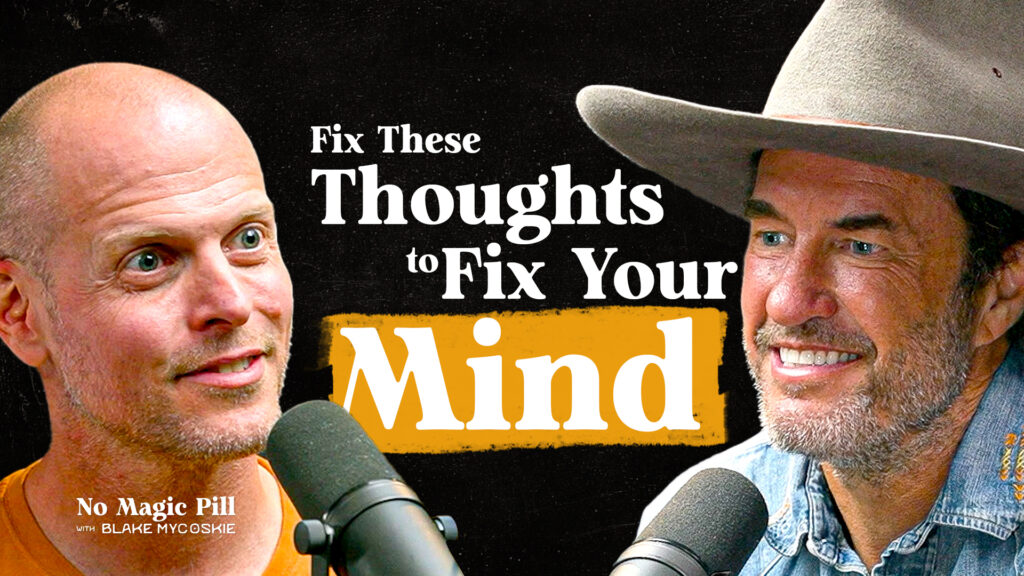
In this episode of No Magic Pill, Blake Mycoskie sits down with Tim Ferriss, author, investor, and master experimenter in treating mental illness in unconventional ways, and one of Blake’s top dream guests for this show. Tim went through four to eight depressive episodes a year growing up, more than fifty in all. Today they come about once every two years, and he describes the difference as living as two completely different people.
Friends for nearly 20 years, the two go deeper than they ever have: why high performers so often crash after their biggest wins, the college semester when Tim set a date to end his life and the mailed postcard that broke the spell, and the tools that changed everything, in the exact order he uses them. It is a conversation built for anyone who feels like they have tried everything and nothing has worked, and it ends with the one thing Tim believes comes closest to a magic pill: the people in your life.
“If you want to improve all the other things, focus on your relationships. We are not evolved to be solitary creatures.”
~ Tim Ferriss
What You’ll Learn
- Why high performers so often crash after their biggest wins, and what the crash is trying to say
- The order Tim sequences his tools: biology first, then brain stimulation, then everything else, each with serious caution
- Why depression can be a check engine light for a life that is off track, and the simple test for when to ask for help
- The state, story, strategy framework, and why connection is the closest thing to a magic pill we have
The Conversation
Why High Performers Crash After Their Biggest Wins
Blake opens with the pattern he lived after selling TOMS, and Tim maps the territory: there are different species of crash. One is identity-based, the Olympian after the Olympics, the Navy SEAL turned entry-level salesperson, the founder after the exit. Another is the body simply presenting the bill after a long sprint, because the mind and body are one circuit, and sixth gear is a very effective way to keep the hard things locked in the basement. Take away the volume of activity, Tim says, and something knocks on the door. Blake recognizes his own version instantly: the incessant need for external validation that kept his core wound quiet right up until the day he sold the company.
The Postcard That Broke the Spell
Tim takes Blake back to his darkest chapter: the college semester when, after dozens of depressive episodes and deep isolation, he set a date to end his life and planned it in detail. What interrupted it was almost absurd chance. A library book he had requested was unavailable, and the notification postcard went to an outdated address on file, his parents’ house. His mom called, and the spell broke. The essay he later wrote about it, Some Practical Thoughts on Suicide, has hundreds of comments from people who pulled themselves out, and the conversation distills the two realizations that anchor it: the devastation suicide detonates in the people who love you, and the simplest test Tim knows for when to act: if you are asking yourself whether you need help, you probably need help.
Biology First: The Three Legs of the Stool
Asked what he has in place now, Tim lays out the three legs of his current approach, in order, with the repeated caveat that he is not a doctor and this is what works for him. First, biology over content: before analyzing the story of your life, look at the machine, from metabolic psychiatry and nutrition to comprehensive blood work, because a deficiency or a metabolic problem can masquerade as a character flaw. Second, brain stimulation, where a recent one-day protocol took his lifelong generalized anxiety from a nine out of ten to nearly zero, a result that has held for months. Third, and only third, psychedelic-assisted therapies, which he calls nuclear power: genuinely powerful, and able to cut in every direction, which is exactly why they come last and with the most caveats. Exercise and the fundamentals, he adds, are non-negotiable underneath all of it.
The Check Engine Light and the Cost of Suffering in Silence
Blake shares the reframe that changed his own recovery, depression as a check engine light of the soul, and Tim pressure-tests it against his own history: the dark period at the end of an impossible book deadline, running on stimulants, sleeping in fragments, and staying years too long in a relationship because he needed a life raft even if it was covered in thorns. His unspoken mantra then was suffer in silence, why inconvenience anyone. What cracked it open was a friend insisting on a practice he was sure was a scam, which became transformative. The two also compare notes on Blake’s misdiagnosis years, the four medications that numbed two years of his memory, and the careful six-month taper that began his way back, a reminder that the signal is worth listening to and the way out is rarely the way you expect.
The 40-Day Mantra and the Slow Road
Blake tells the full story behind the Enough bracelet for anyone who has not heard it: the mala his psychiatrist hand-made, the promise to sit twice a day for 40 days repeating “I am enough, I’ve always been enough,” the third week where nothing seemed to happen, and the day it finally landed in his body for maybe the first time in his life. Tim’s response is pure Tim: content matters, and so does sequence. His now-famous advice for anyone who feels pulled toward stronger medicine is a long on-ramp of daily meditation, the book Awareness by Anthony de Mello, which both men call one of the greatest books of all time, and scheduled breathwork, before anything else is even considered. If you do not feel meaningfully pulled, his first rule is simple: do not. And the quiet genius of the slow road, he admits, is that by the time most people finish the preparation, they have already changed their lives.
State, Story, Strategy, and the Closest Thing to a Magic Pill
For the listener who is not in crisis but just not feeling good about life, Tim borrows a sequencing framework from Tony Robbins: state, story, strategy, in that order. Change the body first, with cold exposure, sixty seconds of jump rope facing the sun, interval training like the Norwegian 4×4 that has been shown to produce durable changes in the brain, or just a walk, because once your state improves, the story improves on its own, and only then is strategy worth the ink. At the top of his own journal, in all caps, it says exactly that. They close on what people get wrong about the world’s most famous optimizer: he cares far less about efficiency than effectiveness, doing the right things rather than doing things right, and the one thing he is focused on now that makes everything else easier is his most important relationships. There is no magic pill, Blake agrees, but relationships might be the closest thing we have got.
About Tim Ferriss
Tim Ferriss is a five-time #1 New York Times bestselling author, including The 4-Hour Workweek and Tools of Titans, an early-stage investor, and host of The Tim Ferriss Show, one of the most popular podcasts in the world. He has been one of the most influential public voices on experimental approaches to mental health, and a major funder of scientific research on psychedelic-assisted therapies. His essay Some Practical Thoughts on Suicide has helped hundreds of readers through their darkest moments.
Links
Website: https://tim.blog/
More from Blake
Enough Foundation
Enough exists to spread reminders in every form, from bracelets to messages to actions to community, until feeling enough becomes the cultural default. Learn more at weareenough.co.
Morning Water
A daily hydration formula that restores energy, balance, and performance with essential electrolytes, minerals, and nutrients in one simple routine.
Learn more at morningwater.co and use code NOMAGICPILL for 25% off your first order.
SONIA
A conversational AI companion built for emotional support, offering guided wellbeing sessions through voice and text, including meditations, journaling, personalized recommendations, and practical exercises. Learn more at soniahealth.com or download it on the App Store.
MOOVLAB
Health and wellness brought into your workday. The answer to sitting is moving. Learn more at moovlab.com.
Follow Blake on Instagram at @blakemycoskie.
This episode is for informational and entertainment purposes only and is not intended as medical advice. Always consult a qualified healthcare professional with any medical questions or concerns.

